Spring 1927
Spring 1927
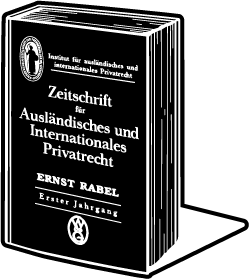
The first issue of the Journal of Foreign and International Private Law is published. As publisher of the journal – now commonly known as The Rabel Journal – the Institute quickly establishes itself as a centre for comparative law and private international law. Over the years the Institute fosters many talented young researchers on their way to illustrious careers as legal scholars in Germany and abroad. Rabel also lays the foundations for the Institute’s law library.


As with other institutes of the Kaiser Wilhelm Society, the Institute of Foreign and International Private Law follows the “Harnack Principle”, which is still adhered to today and refers to the structuring of individual institutes around preeminent researchers, such as Ernst Rabel, who are given broad freedom to shape their institute’s academic agenda. Rabel sets up country desks (Länderreferate) whose staff members are responsible for generating information on the laws, decrees, court rulings, academic literature, and other important legal developments in a given jurisdiction. Their findings are then published as country reports in the Institute’s journal.
Rabel’s expertise and reputation attract to the Institute exceptional scholars such as Ernst von Caemmerer, Walter Hallstein, Gerhard Kegel, Max Rheinstein, Gerhard Schröder, Wilhelm Wengler, and Martin Wolff, among others.

Max Rheinstein
Max Rheinstein is the first director of the law library and a close associate of Ernst Rabel who helps shape the Institute’s early years. Following the enactment of the Law for the Restoration of the Professional Civil Service in April 1933, Rabel turns to Max Planck in defence of Rheinstein’s position. Yet Rheinstein fears the loss his profession and chooses to remain in the United States. He teaches at the University of Chicago Law School from 1935 to 1968.
© MPIPRIV

Anne-Gudrun Meier-Scherling
Gender-based inequality was particularly pronounced in the legal field, and it was not until the Weimar Republic that women could join the legal profession. As a result, women are rare exceptions during the Institute’s early years. Joining the Institute in 1929, Anne-Gudrun Meier-Scherling is likely the first female research assistant. After the war, she becomes the first female judge on the Federal Social Court.
© Christiane Zschetzschingck, Kassel

Martin Wolff
Martin Wolff (1872–1953) was a law professor in Marburg, Bonn, and, from 1921, Berlin. He is known as a gifted instructor who lectures to overflowing audiences. As a research associate at the newly founded Institute, he works closely with Ernst Rabel. Due to his Jewish heritage, Wolff is removed from his chair at the University of Berlin in 1935 and emigrates to England in 1938.
© MPIPRIV

Ernst von Caemmerer
Ernst von Caemmerer is one of Ernst Rabel’s first research assistants at the Institute. As a dedicated assistant and later as a research fellow, he contributes to Rabel’s treatise, Das Recht des Warenkaufs. These efforts deepen his interest in comparative law. A long-time professor at the University of Freiburg, von Caemmerer, like his mentor Rabel, goes on to become a renowned authority on comparative and private international law.
© MPG Archives


During this period, Rabel undertakes three large-scale projects that result in publications still of importance today: Rechtsvergleichendes Handwörterbuch für das Zivil- und Handelsrecht des In- und Auslands (1927-1940), the series Zivilgesetze der Gegenwart (1928-1939), and Das Recht des Warenkaufs (Vol. I 1936, Vol. II, 1958).
Comparative legal research requires a broad base of foreign literature. Accordingly, Rabel promptly sees to the creation of a library that in only six years grows to encompass 20,000 volumes. The collection is housed in the Berlin Palace together with the library of the Institute for Foreign Public and International Law, thereby allowing the staff of either institute to use both libraries.