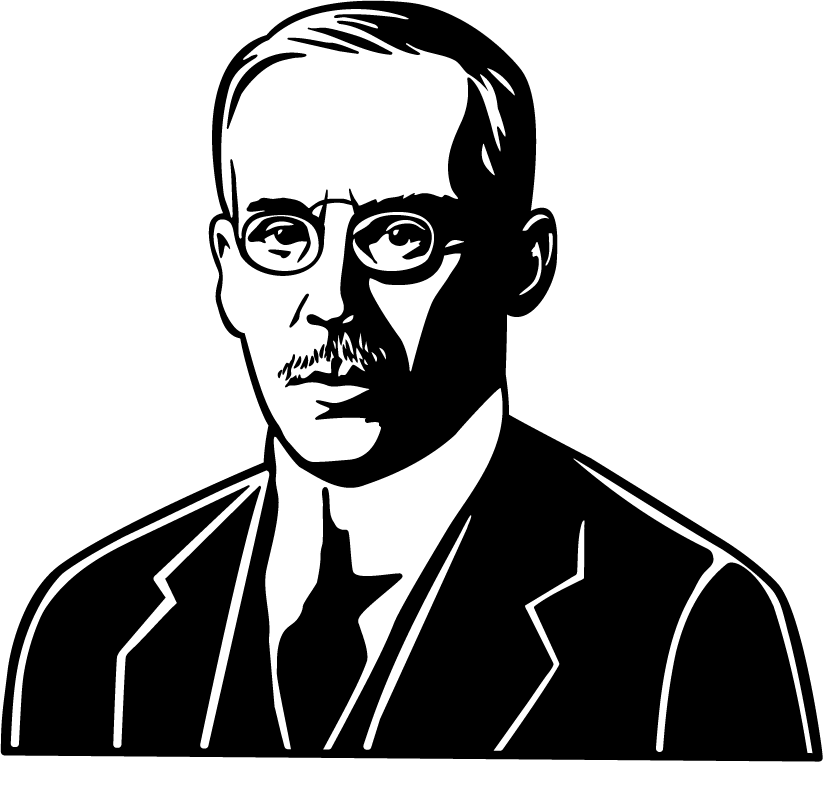
15 February 1937
15 February 1937
Under duress from the Nazi regime, Rabel resigns as director at the Institute. Several staff members have faced persecution and been forced out since the Nazis came to power in 1933. Research at the Institute during this period increasingly conforms to the regime’s political and ideological specifications. During the war, Rabel’s successor, Ernst Heymann, tries to position the Institute as relevant to the war effort, for example by producing briefs and country reports about the law of the countries under German military occupation.
Ernst Rabel possessed Jewish ancestry. For a relatively long time he is able to retain his position as director of the Institute, in part owing to the protection of Friedrich Glum, the director general of the Kaiser Wilhelm Society. However, increasing pressure within the Kaiser Wilhelm Society ultimately results in his dismissal in 1937. Rabel had already been removed as dean of the law faculty at the University of Berlin in the spring of 1933. Two years later, on 1 October 1935, he was placed on compulsory leave and shortly thereafter forced to retire from his university post without the privilege of emeritus status. In 1939 Rabel chooses to emigrate to the United States. Rabel’s departure marks the end of the Institute’s first internationally oriented phase.
At least six other staff members before Rabel are forced to leave the Institute as a consequence of Nazi racial ideology: Alice Breu (secretary), Felix Eckstein (research fellow), Friedrich Kessler (research fellow), Max Rheinstein (senior research fellow, library director, administrative director), Stefan Albrecht Riesenfeld (research assistant), and Martin Wolff (scientific member).
Documents
(Click on the image to view a larger version)

Letter from Ernst Rabel dated 1933 to the president of the Kaiser Wilhelm Institute regarding firings pursuant to the Law for the Restoration of the Professional Civil Service enacted by the Nazi regime

Protocol of a meeting dated 1936 about organizing a new leader for the Institute of Foreign and International Private Law

The president of the Kaiser Wilhelm Society, Max Planck, expresses his thanks to Rabel in a letter dated 5 February 1937.

Affidavit of support by Max Rheinstein regarding Ernst Rabel’s entry into the United States


Rabel’s successor, Ernst Heymann, is a reputable legal scholar, but he cannot match Rabel’s brilliance or international reputation. Given that Heymann is already 66 years old, he is destined to be a transitional figure. Although Heymann is not a member of the NSDAP and has not authored ideologically driven tracts, he accommodates the Nazi agenda and, as dean of the law faculty of the University of Berlin, actively participates in its Nazi reorganization.
The ideological adjustments under Heymann are also reflected in the articles and topics covered by the Journal of Foreign and International Private Law. After the outbreak of World War II, the Institute begins to focus on issues of foreign law related to the war economy. At the same time, ideologically influenced topics such as race and Lebensraum play a greater role.


These shifts are also evident in the country reports. Reports on jurisdictions dubbed “enemy states” decline, while those on territories occupied or influenced by Germany receive more comprehensive coverage.
Video:
Der Nachfolger: Leben, Werk und Wirken von Ernst Heymann (1870–1946)
Lecture by Reinhard Zimmermann
(in German)
On 18 May 2026, the Max Planck Institute for Comparative and International Private Law celebrated the kickoff of its 100th anniversary. On this occasion, Reinhard Zimmermann gave a lecture on the Institute’s second director.


From left to right: Joachim-Dieter Bloch, Ursula Grunow, Alexander N. Makarov und Hermann Mosler